Aorta
The body's largest artery. It leaves the heart, arches over it, and runs down the back of the chest and abdomen, dividing into the two common iliac arteries at about the level of the navel.
- Carries
- Oxygen-rich blood
- Begins at
- The left ventricle
Carotid arteries
Run up each side of the neck to supply the head and brain. The pulse in the neck is felt over them.
- Supply
- Head and brain
- Pulse point
- The side of the neck
Subclavian arteries
Run beneath the collarbones and out to each arm.
- Supply
- The arms
- Continue as
- Axillary, then brachial arteries
Brachial arteries
The main artery of the upper arm. A blood-pressure cuff listens to it at the inside of the elbow.
- Runs along
- The inside of the upper arm
- Pulse point
- Inside the elbow
Radial arteries
Run down the thumb side of each forearm. The pulse is usually taken over the radial artery at the wrist.
- Runs along
- The thumb side of the forearm
- Pulse point
- The wrist
Renal arteries
Short, wide arteries carrying blood to the kidneys, which filter it.
Supply: The kidneys
Common iliac arteries
The aorta's two final branches, supplying the pelvis and the legs.
- Branch from
- The aorta
- Supply
- Pelvis and legs
Femoral arteries
The main artery of each thigh. A pulse can be felt in the groin.
- Supply
- The thigh and leg
- Pulse point
- The groin
Tibial arteries
Continue from the artery behind the knee to supply the lower leg and the foot.
- Supply
- Lower leg and foot
- Pulse point
- Behind the inner ankle
Superior vena cava
Returns blood from the head, neck and arms to the heart.
- Carries
- Oxygen-poor blood
- Empties into
- The right atrium
Inferior vena cava
Returns blood from the lower body to the heart. It is the largest vein in the body.
- Carries
- Oxygen-poor blood
- Empties into
- The right atrium
Jugular veins
Drain blood from the head and neck, running down each side of the neck.
Drain: Head and neck
Subclavian veins
Return blood from each arm and join the jugular veins on their way to the heart.
Drain: The arms
Basilic veins
Run up the inner side of each arm. The veins at the inside of the elbow are where blood is usually drawn.
- Drain
- Hand and arm
- Lies
- Just under the skin
Renal veins
Return filtered blood from the kidneys to the inferior vena cava.
Drain: The kidneys
Common iliac veins
Return blood from the legs and pelvis, and join to form the inferior vena cava.
Join to form: The inferior vena cava
Femoral veins
Run alongside the femoral arteries, returning blood from the thighs and legs.
Drain: The thigh and leg
Great saphenous veins
Run up the inside of each leg, from the foot to the groin, just under the skin. They are the longest veins in the body.
- Runs
- From foot to groin
- Known for
- The body's longest veins
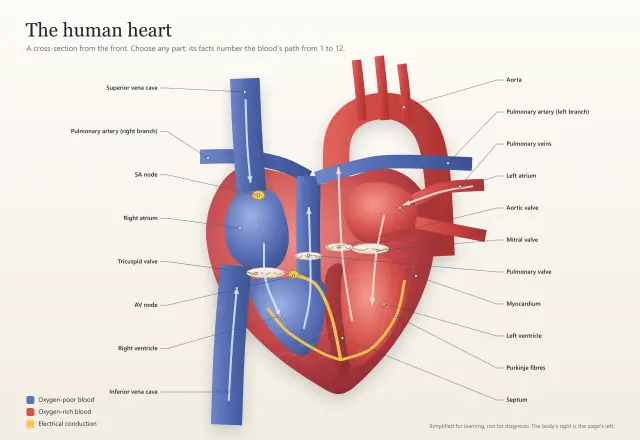
Heart
The pump at the centre of it all: the right side sends blood to the lungs, the left side to the rest of the body.
- Chambers
- Four
- Pumps
- Both circuits at once