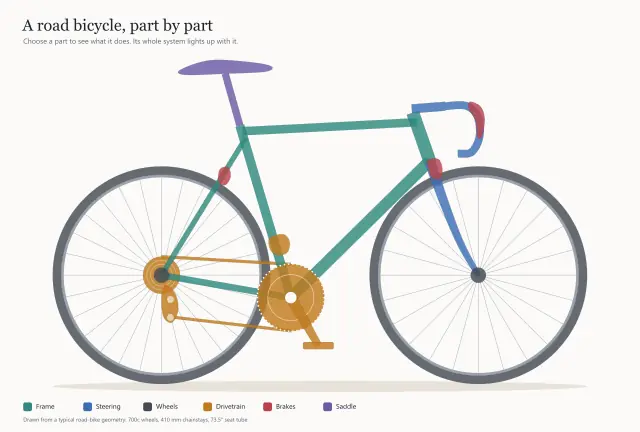
Wheels and tyres
Low-rolling-resistance tyres, often with foam inside to quieten road noise that an engine used to hide.
- Tyres
- Low rolling resistance
- Often
- Foam-lined, for quiet
An engineering page: the battery, motors and charging under an electric car, filed by what each does.
The same content as the picture, as text: every part and what it says when you open it.
Low-rolling-resistance tyres, often with foam inside to quieten road noise that an engine used to hide.
Thousands of lithium-ion cells in modules, sealed in a flat case that forms the floor of the car. Low and central, it also gives the car its low centre of gravity.
The motor, a single-speed reduction gear and the differential in one housing, driving the rear wheels.
A second motor for the front wheels makes the car all-wheel drive, and it can switch off when cruising to save energy.
Turns the battery's direct current into the alternating current the motor runs on, and back again when the car brakes and the motor becomes a generator.
Converts mains AC from a home wallbox into DC for the battery. A rapid charger supplies DC directly and bypasses it, which is why rapid charging is so much faster.
The socket for both AC and DC charging - CCS2 in Europe and India, NACS or CCS1 in North America.
With no engine in front, the space becomes luggage room - the 'frunk'.
Typical size: 50–150 litres
A small conventional battery that powers the lights, locks, screens and computers, and wakes the high-voltage system.
Keeps the battery in its comfortable range and heats the cabin. A heat pump moves heat rather than making it, which saves range in cold weather.
Turns the front wheels, with electric power assistance - there is no engine to drive a hydraulic pump.
Assistance: Electric
Springs and dampers at each corner. The heavy battery sits between them, so the car rides flat through corners.
Per corner: A spring and a damper
Thick shielded cables between the battery, the drive units and the charger, always sheathed in orange so nobody mistakes them for low voltage.
Watches, cameras, engines and phones, every part named and explained.