Solar panels
Twelve panels facing the sun. They make direct current whenever there is daylight, and most around midday.
- Panels
- 12 × 420 W
- System size
- About 5 kWp
- A year's output
- Roughly 4,000–5,500 kWh, by location
A system, not one product: panels, battery, charger and heat pump in a cut-away house.
The same content as the picture, as text: every part and what it says when you open it.
Twelve panels facing the sun. They make direct current whenever there is daylight, and most around midday.
Turns the panels' direct current into the alternating current the house uses, and decides where each kilowatt goes: the house first, then the battery, then the car, then the grid.
Stores the afternoon's surplus for the evening, when the panels stop and the house is busiest.
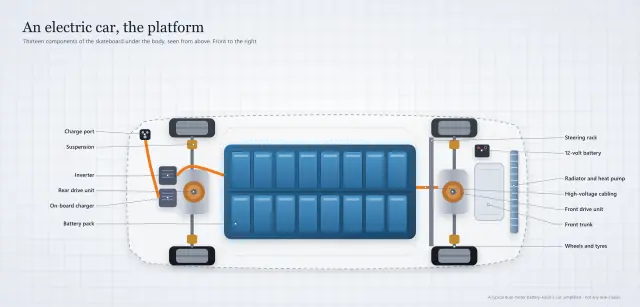
The biggest battery on the property. Charged from surplus solar in the day, or cheap night-time power.
A wall-mounted charger. In solar mode it follows the panels, charging faster as the sun comes out.
Heats the house and the water by moving heat from the outside air, even on cold days.
Stores hot water. A diverter can heat it with surplus solar power that would otherwise be exported for very little.
The fuse box: every circuit in the house, with the solar system on a circuit of its own.
Measures what the house takes from the grid and what it sends back, half-hour by half-hour.
The house still draws from the grid at night and in winter, and sells surplus back on sunny days.
Watches, cameras, engines and phones, every part named and explained.